The Futility of Being
A mistaken spark in an eternal night

“ Time is that by virtue of which everything becomes nothingness in our hands and loses all real value ”
— Arthur Schopenhauer
Being truly content with our lives, without any want or Will, is antithetical to our very own human nature. For we are not the beings of peace, but of pursuit. But do we observe the transient nature of reality, and how our lives might not hold as much pride as we believe?
The Structure of Existence
This vainglory of existence is evident from the structure it assumes. But we seldom dare to see it. If a cosmic eye could observe all of time, our lives would disappear in the blink of an eye. We are, at best, an accidental flicker in an endless void of darkness. And even this flicker is forgotten instantly. Present, therefore, is the sole form of actuality that we ever touch before it fades into broken memories. Our stories, voices, pain, and joys are but a whisper in an endless abyss of the cosmos. Only art and knowledge can sail through eternity, which often goes unheeded.

Time thus brings perishability to the entirety that exists within it. It’s akin to a storm, merciless and devastating, and against it stands the inevitable Will to Live, screaming again and again only to confront its own meaninglessness through the storm.
The Transient Reality
Anything which has been, which no more is; it exists as little as anything which has never been. Everything that is will be a matter of the past in the very next moment. Any pride, or victory, or fear that is now, will not be there. Thus, the trivial present has more actuality than the glorious past, which is not there anymore. The past is nothing, the present is something.

We arrived after eons of silence, and we’ll be gone for longer still. Whatever tragic arrogance exists in between is what we call life.
But we are deprived of this reason by our emotional intuition. Our heart repeatedly reassures us that our lives must mean more than that. Every new morning, we are one day closer to death. We must go frantic upon learning about our mortality, but we do not. Not because we are unafraid of death, but men tend to find solace in a secretly conscious thought of being attached to something eternal in some manner. Many discover a profound sense of peace in the concepts of religious or spiritual eternity, whether it’s the promise of heaven or the cycle of rebirth. Others draw comfort from the everlasting cycle of the universe, while others cherish a vivid memory or the legacy they might leave behind.
The eventual concern that arises is what to do with the sole part of reality that we experience.
- Shall we enjoy every present moment and make enjoyment the goal of life, since the present is the only reality?
- Or, for something that vanishes the very next moment, can it be worthy of any toil or serious effort?
There is no correct answer.
We must transcendentally observe reality outside the confines of ethical considerations.
The Phantasm of Imperishability
“Existence is typified by unrest”
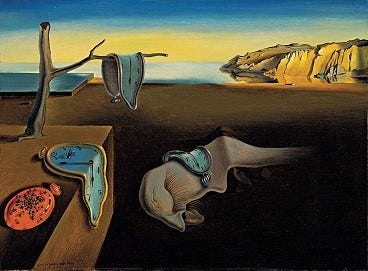
The form that existence assumes has no state upon which it can rest. It is built upon incessant motion, where exists no state of rest or peace that we long for. If the Earth stops dead in its orbit, it crashes right into the sun. If particles stopped moving, our understanding of the universe and its laws would be disrupted. But there is no state where the Earth will have peace after orbiting the sun repeatedly, nor will the particles. And so do we.
Given the continual flow and impermanence of the universe, how do we expect to achieve the happiness that we long for? Happiness, dreams, and joys are like mirages that disappear just as we reach them. In a reality where nothing is permanent, but Plato’s “Continual Becoming and Never Being”, the peace we long for never is.
A man’s life ends up with either disappointment or nothing at all. In the first case, the man chases after the happiness he dreamt of, which he seldom finds, only to suffer. At last, he reaches the end of his time, tormented and disappointed.
In the second scenario, the joys and pain, the happiness and misery, the whole expedition doesn’t matter at all. For what was no more is. And life, a collection of transient moments, has come to an end. The journey’s end has arrived, which is the only imperishable conclusion: Death.
The Ignorance & the Regret
Happiness in our lives that we envision looks exquisite from afar. It is the moment we arrive close to them when we confront their emptiness. Our hunger, no matter how delicious the feast is, returns even if satisfied. Thus, to achieve something is to discover the excessive pride it contains, its vanity.

We all live in expectations of better lives, while secretly longing for the past with regret. The past, which we let go unregarded and unenjoyed, was precisely the life that in expectation of which we lived. By the time we realize this, ages pass.
We Are, but Why?
With the life that we are given, the first task is to earn a living — money for food, shelter, and clothes — which, when achieved, is a burden itself. We confront its true nature, which is not peace but boredom. The second task is to figure out what to do with the earned living. We become unconscious of the things we have earned, and repeat the same routine so as to have a need to live, to ward off boredom.

With all the afflictions and boredom faced in order to achieve a state of serenity, we often forget to question the life itself. Why exist at all?
A man’s life is filled with desires that are difficult to satisfy. And even if satisfied, he feels not bliss but boredom. If our lives contained anything positive, boredom should not have existed at all. Our existence should have satisfied us. But we only take pleasure in existence when
- When we strive after our desires, only to be disappointed later
- When we take part in intellectual pleasures — art, music, dance, cinema — not as characters but as if spectators at play. No moral considerations, just observations.
The difficult path to a distant dream seems as if it would satisfy us, with this illusion only to be fading after we reach it. This moment, when we are redirected back to the existence — and its emptiness, its vanity, worthlessness — this sudden consciousness and confrontation with the reality is what Schopenhauer defined as Boredom.
A man is born as a consequence of coition, and ends as a stinking corpse. Between the two ends, we grow up, build the Will to live, we suffer pain & injustice to fulfill this will, chase after dreams to feel good, only to be crumbled to dust. Everything is given over to annihilation. So why exist at all?
Are our lives a mistake, a sin, an error, or something that we are not yet ready to comprehend? We might never understand the objective behind our beingness. For Life is a process of disillusionment, and every event in our life is calculated precisely to produce this fragmentation, to break the false mirror of hope, and expose the harsh realities of existence itself. All I could conclude is that our lives are insignificant in an enormously large nothingness, and I shall live it not with pride but humility.
It reminded me of Tolkien, as he said,
“All we have to decide is what to do with the time that is given us”
I embrace this life as it is, with all the pain and nothingness.
Do you?